DevOps & observability / Opinion
Runbooks That Get Used at 3 a.m.: Structure, Triggers, and the Last Verified Step
Write runbooks an exhausted engineer can execute at 3 a.m.: symptom-based triggers, numbered verifiable steps, explicit stop conditions, and a maintenance loop.
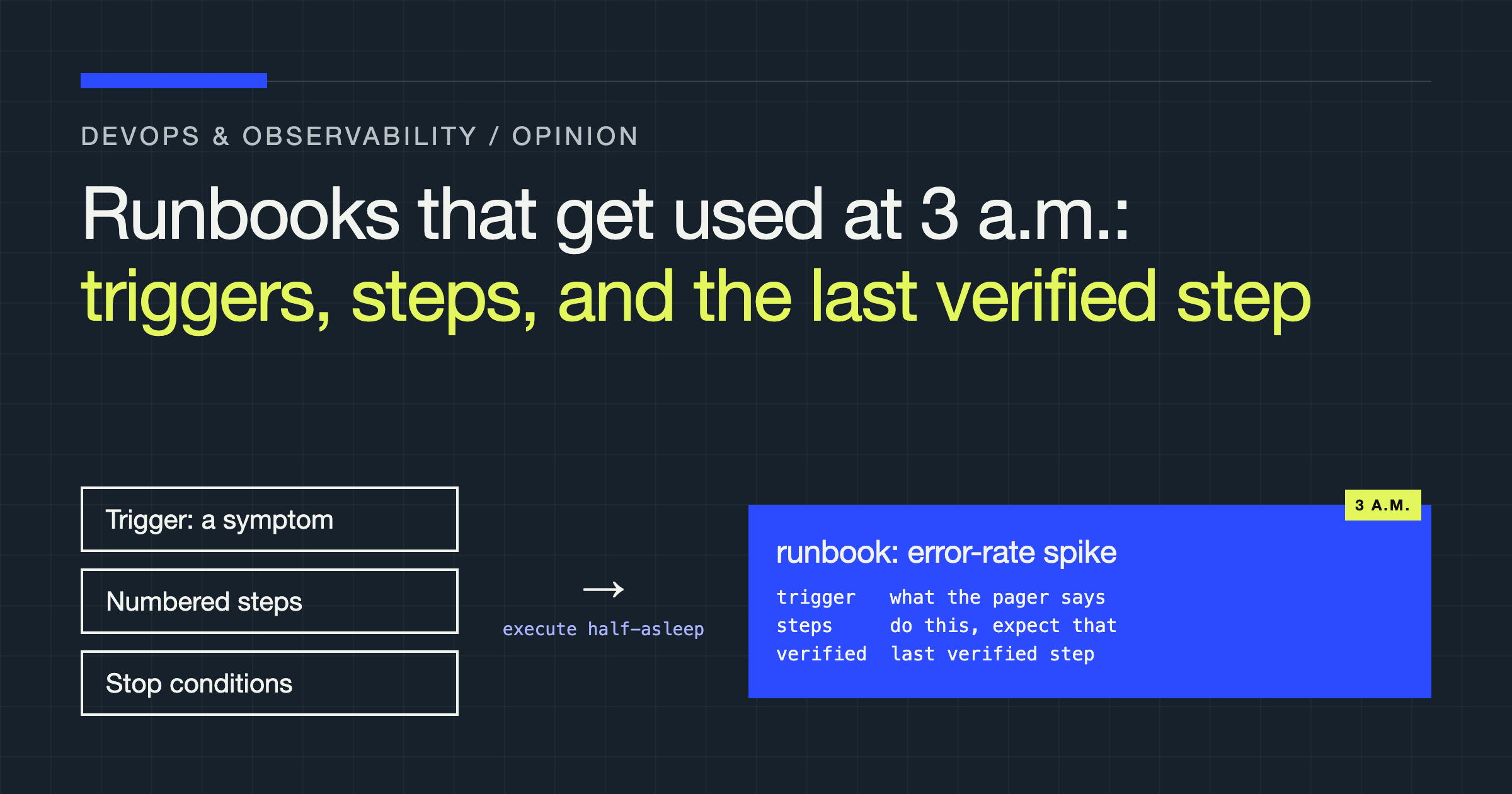
You will not write your best prose at 3 a.m., and neither will anyone on your team. That is the whole argument of this article: a runbook is not documentation about a system, it is a tool used by a sleep-deprived person whose working memory is measurably smaller than the person who wrote it. Most runbooks are written for the second person and judged, during an incident, by the first. The gap between those readers is where incidents get longer.
This is an opinion piece, and the opinion is specific. Runbooks fail for structural reasons that are fixable: they are organised by system instead of by symptom, they describe instead of instruct, they never say when to stop, and nobody owns their decay. Fix the structure and the same team, with the same knowledge, resolves incidents faster and with less variance between the strongest and weakest responder.
Organise by symptom, because that is how incidents arrive
Nobody is paged with a root cause. You are paged with a signal: an alert fires, a dashboard reddens, a customer reports that checkout is failing. The runbook library should be indexed the way the problem presents, which means the entry point is the alert or the symptom, not the architecture diagram.
Practically, this means every alert that can page a human links directly to exactly one runbook, and the runbook’s title is the symptom in the words the alert uses. “Elevated API error rate” is a runbook title. “The API tier” is not; it is a chapter heading in a system description, and at 3 a.m. the responder has to translate their symptom into your taxonomy before they can start, spending the scarcest resource they have, attention, on navigation.
Inside the runbook, keep the symptom-first discipline. The first screen should answer three questions in order: is this the right runbook, how bad is it, and what is the first thing to check. Everything else, background, architecture, history, goes below, where it can be read during a calm moment rather than scrolled past during a bad one.
Steps are instructions, and instructions have a grammar
Compare two lines from two runbooks for the same problem.
The first says: “Check whether the queue consumers are keeping up with the backlog.” The second says: “Run kubectl get pods -n workers and confirm every consumer pod shows Running and a restart count under 3. If any pod shows CrashLoopBackOff, go to step 6.”
The first line is a description of a goal. It requires the responder to know how to check, what healthy looks like, and what to do with the answer, which is to say it requires the responder to already know the runbook’s contents. The second line is an instruction: a concrete action, an observable expected result, and a branch. Only the second survives contact with fatigue.
Every step in a runbook should carry those three parts: the exact action, the expected observation, and the branch when the observation differs. Exact means copy-pasteable commands with the real namespaces, real service names, and placeholders the responder replaces, marked so they cannot be missed. Expected means numbers or states where you can give them, because “check the dashboard” leaves the responder to guess which panel and which threshold, while “the error panel should show a rate falling within two refresh cycles” tells them when they are done.
STEP 4 — Verify the drain completed
Run:    kubectl get pods -n payments -l app=checkout
Expect: all pods Running, READY 1/1, no pod younger than the deploy
        timestamp unless it replaced a drained pod.
If not: a pod in Pending for more than 5 minutes means the node
        pool is full. Stop here and escalate to the platform
        channel; do not proceed to step 5.
Notice the last element of that step: a stop condition. It deserves its own section.
Every runbook needs explicit stop conditions
The most dangerous moment in an incident is a confident responder following steps that have stopped matching reality. Systems drift, the incident in front of you is a cousin of the one the runbook was written for, and the steps begin producing results the author never saw. A runbook without stop conditions has no way to say “this is no longer your incident”.
Write them as plainly as the steps: if the deploy timeline shows no change in the window, this is not a bad deploy, stop and re-triage. If draining one instance does not move the error rate, do not drain a second; you are treating a symptom you have not located. If you reach a step you do not understand, that is itself a stop condition, and the correct action is to escalate, not to improvise around the gap.
Escalation is a step, not an admission. Name the channel, the team, or the role, and the information to hand over: what you ran, what you observed, which step you stopped at. A responder who escalates with that summary has done their job well, and the runbook should say so, because teams get the escalation behaviour their documents reward.
The last verified step is the maintenance contract
Here is the practice that keeps everything above true, and it is the one teams resist because it sounds like paperwork. Every runbook ends with a closing block the responder completes during or immediately after the incident:
| Field | What the responder records |
|---|---|
| Last step verified | The highest step number executed and confirmed to behave as written |
| Deviations | Any step whose command, output, or branch did not match reality |
| Stop condition hit | Which stop or escalation condition ended the runbook’s usefulness, if any |
| Time to mitigate | When the symptom cleared, in the responder’s judgement |
“Last verified step” is the load-bearing field. It converts every incident into a partial review of the document: steps up to that number were executed against the real system, under real pressure, and behaved as written. Steps beyond it are unverified, and deviations recorded against specific steps are a precise, prioritised work list for the follow-up. Compare this with the usual arrangement, where runbook quality is assessed in an annual documentation review by people reading calmly at desks, which is to say it is never really assessed at all.
The follow-through has to be cheap or it will not happen. File the deviations as edits to the runbook itself, reviewed like code, owned by the team that owns the service. A runbook that was wrong during an incident and is still wrong a month later teaches responders to stop trusting all runbooks, and that cynicism is earned.
What to leave out
A runbook is not the place for the system’s history, the postmortem of the last incident, or a tutorial on the underlying technology. Link to all of those; include none of them. Length is a cost paid by the reader at the worst moment, and every paragraph of background is a paragraph between the responder and the next action. The test for any line is whether it changes what the responder does or decides in this incident. If it informs but does not steer, it belongs in the linked material.
Also leave out steps that require judgement the document cannot support. “Decide whether the traffic pattern looks malicious” is not a step; it is a delegation of the hardest part. Either give the responder the observable criteria, the thresholds, the example patterns, or make the step an escalation to someone whose job holds that judgement. Pretending a hard call is a checkbox fools the author, not the incident.
Verdict
Write runbooks for the reader who is tired, interrupted, and possibly new: indexed by the symptom the alert announces, built from steps that pair an exact action with an expected observation and a branch, and bounded by stop conditions that give the responder permission to stop following the document when reality diverges from it. Close every incident by recording the last verified step and the deviations, and fold those back into the document while the memory is fresh. A runbook maintained that way stops being documentation about the system and becomes what it should have been all along: the team’s incident experience, written down where the next tired person can spend it.