Documentation & DX / Docs teardown
Docs Teardown: What Vercel's Documentation Gets Right About Developer Journeys
A teardown of Vercel's docs: how task-based navigation, framework-aware content, and honest limits pages turn a platform manual into a guided developer journey.
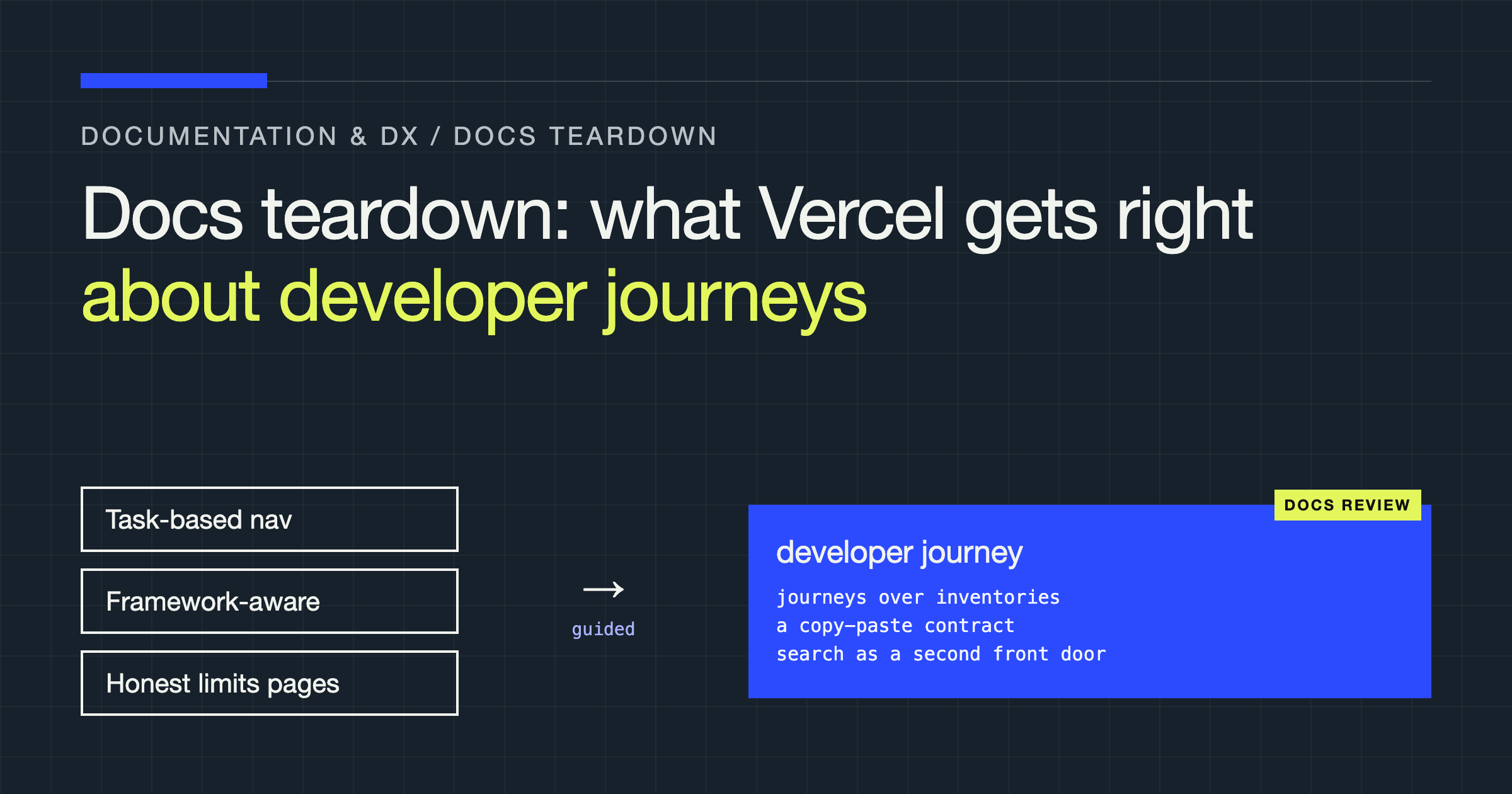
You will finish this teardown able to judge any documentation site by one standard: does it move a developer from intention to working result with the fewest possible decisions in between? Vercel’s documentation is a useful specimen because it is not organised like a manual. It is organised like a journey, and that choice shapes everything from its navigation to how it writes about its own limits.
The structural bet: journeys over inventories
Most platform docs are inventories. Every feature gets a page, pages are grouped by product area, and the developer’s job is to translate their goal into the vendor’s taxonomy before they can start. If you want to ship a site, you first have to learn how the vendor thinks about shipping sites.
Vercel’s docs make the opposite bet. The top-level structure leans heavily on tasks and outcomes — deploy, observe, secure, scale — rather than internal product boundaries. A feature still exists underneath, but the entry points are phrased around what you are trying to do. This matters more than it sounds. Documentation navigation is a promise about whose mental model wins: the company’s org chart, or the reader’s goal. Vercel consistently lets the reader’s goal win at the top level, then switches to product structure once you are inside a topic and oriented.
The trade-off is real. Task-based navigation duplicates content, because the same underlying capability legitimately appears in several journeys. It also ages faster: when the product reorganises, task pages survive, but the mapping between journeys and features needs maintenance. Vercel absorbs that cost because discovery, not completeness, is its bottleneck. A first-time deployer who cannot find the right page in ninety seconds does not file a docs bug; they leave.
Framework-aware content without forking the docs
Vercel’s hardest documentation problem is that it hosts everyone else’s frameworks. A deployment guide that is correct for Next.js can be wrong for a static site generator and irrelevant for a Python backend. Lesser docs solve this by writing the generic version and letting framework users fend for themselves, or by forking into per-framework silos that drift apart.
The approach you see across Vercel’s guides is a shared spine with framework-specific branches: the concept is explained once, in platform terms, and then the implementation steps diverge by framework with clearly signposted variants. Done well — and it mostly is — this gives you three things at once. Search engines index one strong page instead of five thin ones. Fixes to the shared explanation propagate everywhere. And readers learn the platform’s vocabulary while still getting steps in the stack they actually use.
The failure mode of this pattern is the uncanny valley of relevance: a page that is eighty percent applicable to your framework, where the twenty percent that differs is exactly the part that breaks. Vercel mitigates this by being explicit about where the platform behaves identically for everyone (build and deployment mechanics, environment variables, domains) and where behaviour genuinely forks. When you imitate this pattern, that boundary is the whole craft. Mark it clearly or readers will trust the generic text into a broken deploy.
Limits and pricing pages written as documentation
Here is the part of Vercel’s docs most worth copying, and the part most companies refuse to write: the limits documentation. Platform limits are usually buried in pricing pages, phrased as marketing comparisons, or scattered across support articles you find only after hitting the limit in production.
Vercel treats limits as a first-class documentation topic. Its limits reference states what the constraints are in plain terms, organised by resource, in the same documentation system as the how-to guides. That placement is a design decision with teeth:
- It is findable before it hurts. You can read the constraint while designing, not while debugging an outage.
- It is written in engineering language. Limits are stated as properties of the system, which lets you reason about them instead of negotiating with a pricing table.
- It respects the reader. A developer who knows the ceiling can build under it. A developer who discovers it mid-incident remembers the vendor, not the incident.
The trade-off is commercial honesty: published limits give competitors a comparison chart and give critics a citation. Vercel evidently judges that trust compounds faster than the downside. For docs leads, the lesson is not “publish your limits” in the abstract. It is that reference material developers plan around — limits, quotas, timeouts, payload ceilings — belongs in the docs tree with the same rigour as your tutorials, not in a pricing FAQ.
Code samples and the copy-paste contract
Vercel’s guides lean on a convention worth naming: samples are written to be run, not admired. Commands appear in the order you execute them, configuration examples are complete enough to paste, and the surrounding prose explains the why between steps rather than narrating each one. That sounds basic, but it is a contract many docs break. A sample that omits the boring glue — the environment variable, the file location, the install step assumed to be obvious — costs the reader a support search at the exact moment your docs were supposed to save one.
Where the approach strains is version drift. A platform that ships continuously, documented with concrete commands and configuration, accumulates small inaccuracies faster than a platform documented in generalities. Vercel’s mitigation is partly cultural (docs live close to the product teams) and partly structural: concept pages carry the durable truth, and the most volatile specifics sit in reference pages that are cheaper to update. When you borrow the copy-paste contract, borrow that layering too, or your concrete samples become concrete liabilities.
Search as the second front door
A journey-based structure only works if the second front door — search — honours it too. Developers who arrive from a search engine land deep in the tree, often on a reference page, with none of the orientation the navigation was designed to provide. Vercel’s docs handle this better than most in a way that is easy to overlook: pages are written to be landable. Concept introductions restate the essential context instead of assuming you read the previous page, and cross-links point sideways to the task you are probably trying to complete, not just up and down the hierarchy.
This is a discipline worth naming because it conflicts with how docs teams like to write. Restating context feels redundant when you read a docs set linearly, cover to cover, the way its authors do. But almost nobody reads your docs that way. The reader who lands on a reference page from a search result and finds it assumes a journey they never took will leave, even if the page is technically complete. Vercel’s willingness to repeat a sentence of framing on every landable page is not sloppy writing; it is an admission of how documentation is actually consumed, priced into the style.
The corresponding failure mode is real, too: pages bloated with orientation boilerplate that returning readers must wade through to reach the fact they came for. The balance Vercel strikes — a sentence or two of framing, then the substance — is the part to imitate, not the repetition itself. If your framing takes a paragraph, you have written an introduction, not a landing.
The AI surface: docs written for two audiences
One more structural choice deserves attention, because it will define the next era of documentation design. Vercel’s tooling ecosystem is built to be operated by developers and, increasingly, by the AI assistants those developers use. That shifts what documentation is for. A human reader forgives ambiguity and interpolates intent; a model consuming your docs to generate a deployment configuration does not. It needs the same things a careful reference provides: exact property names, complete configuration schemas, unambiguous statements of what is required versus optional.
Docs teams at most companies will face this tension as a conflict: write warmly for humans or precisely for machines. Vercel’s structure suggests the conflict is mostly illusory, because the layering already exists. Concept and guide pages carry the human voice — motivation, judgement, sequencing. Reference pages carry the precision — complete, neutral, exhaustive. A documentation set that keeps those layers honest serves both audiences without compromising either. One that blends them, sprinkling tutorial warmth into reference tables, serves neither. If you take one forward-looking lesson from this teardown, take that: the AI era rewards exactly the discipline Diátaxis-style layering always demanded, and punishes the blended page twice as fast.
What to copy, what to skip
| Pattern | Copy it when | Skip it when |
|---|---|---|
| Task-based top-level navigation | New users arrive with goals, not product knowledge | Your audience is expert-only and searches by feature name |
| Shared spine with framework branches | One platform serves several stacks with common mechanics | Frameworks differ so deeply that shared text misleads |
| Limits as reference docs | Developers design against your constraints | Your limits are genuinely negotiable per contract |
| Runnable, complete code samples | Your product is adopted by trying it | Samples would expose credentials or unsafe defaults |
Verdict
Vercel’s documentation succeeds because it is opinionated about the reader’s path: enter through a goal, learn the platform’s concepts once, branch only where your stack genuinely diverges, and read the limits before the limits read you. Its weaknesses are the honest costs of those strengths — duplicated entry points to maintain, shared text that must be policed at the framework boundary, and concrete samples that drift as the platform ships.
If your docs feel like a well-organised warehouse that nobody can find anything in, the fix is rarely more content. It is Vercel’s first decision, remade on your site: organise the front door around journeys, and let the inventory live one click deeper.