Documentation & DX / Opinion
Changelogs Are Product Writing: Entries Users Read and Releases That Earn Trust
Why the changelog is product writing, not a commit digest, and how to write entries that users actually read and act on.
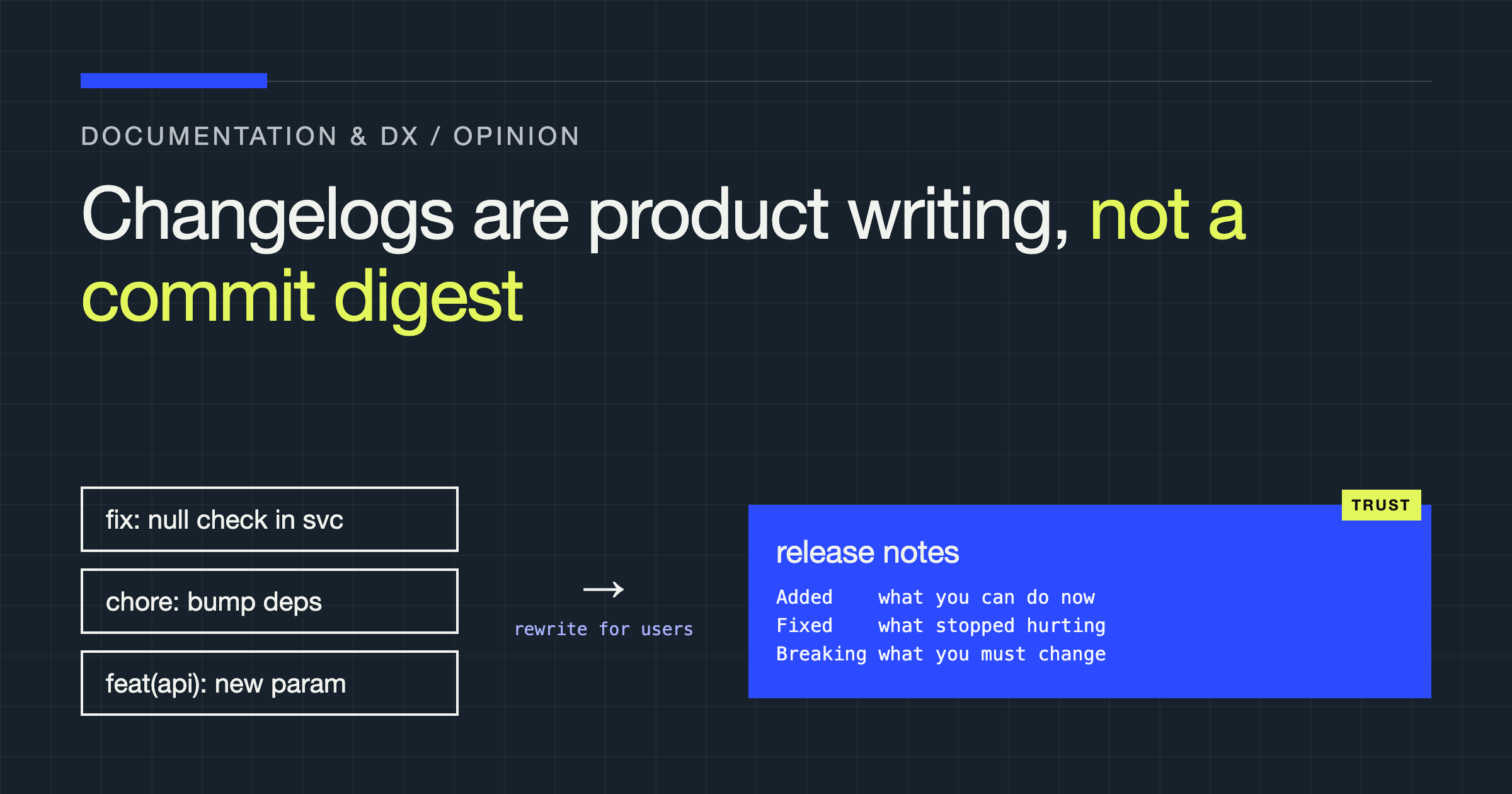
Here is the position this piece will defend, so you can decide whether to keep reading: a changelog is product writing, held to the same standard as your onboarding flow or your pricing page, because for a large share of your users it is the product’s voice between releases. It is the one document that tells users what changed, what it means for the work they already have running, and whether the team behind the tool is paying attention. Treating it as a by-product of the build pipeline, a lightly edited list of merged work, wastes the most regular piece of communication most products ever send.
The commit log is not a changelog
The confusion starts with inputs. Engineers close tickets; tickets become release notes; release notes get published. Each step in that chain is written for a different reader. A commit message is written for the person debugging the code later. A ticket title is written for the team coordinating the work. Neither is written for the person whose integration, workflow, or budget is affected by the change, and no amount of light editing fixes that, because the missing ingredient is not polish. It is translation: from what the team did to what the user experiences.
“Refactored the billing service and resolved several issues” is a faithful summary of work and a useless changelog entry. It tells the reader nothing they can act on. Did prices change? Did an invoice format change? Did a bug that affected their exports get fixed, and should they re-run anything? The writer’s job is to answer the questions the reader brings, not to summarise the questions the team answered. When a changelog reads like an internal status report, users learn to ignore it, and they learn that lesson quickly and permanently.
Write the change from the user’s side of the screen
A usable entry names the change in the vocabulary of the person affected. Users do not think in service names, internal project codenames, or ticket numbers; they think in the tasks and objects the product exposes to them. “You can now filter exports by team” lands. “Added team predicate support to the export subsystem” requires the reader to do your translation work for you, and most will not bother. This is not dumbing down. The internal description can live in the engineering notes where it belongs. The changelog is the outward face, and outward faces speak the reader’s language.
Order matters as much as wording. Readers scan in the order of consequence to them: breaking changes and required actions first, then behavioural changes that might surprise them, then new capabilities, then fixes, then the minor and cosmetic. A changelog that leads with a new dashboard theme while a changed default sits in the fourth paragraph has its priorities inverted, and a reader burned once by that ordering stops trusting the document entirely. Group entries under plain headings that describe the reader’s relationship to the change: what is new, what changed, what was fixed, what was removed, and what requires action. Never make a reader mine a flat list for the one entry that can break their integration.
Breaking changes are a tone test
Nothing in product writing carries more weight per word than a breaking-change entry, because it is read by people deciding whether your team is careful with their work. A good entry does four things without flinching. It says plainly what will stop working or behave differently. It says who is affected, precisely enough that unaffected readers can move on. It gives the migration path, or links to it, in the same breath rather than in a later post. And it gives the timeline in the entry itself, so the reader is not left to infer urgency.
Vagueness here is not kindness. “Some legacy endpoints will be deprecated” creates maximum anxiety and minimum action, the worst possible combination. Compare the honest version: which endpoints, what replaces them, when the old behaviour ends, and what happens to requests that still arrive afterwards. Teams sometimes soften these entries out of a fear of looking bad. The opposite is true. A precise, unhedged breaking-change entry is one of the strongest trust signals a product can send, because it proves the team understands the cost it is imposing and has done the work to minimise it.
Fixes deserve better than a shrug
The fixed section is where changelogs most often insult their readers. “Various bug fixes and improvements” is a sentence that communicates exactly one thing: the team did not think you were worth informing. Every fix that ships was, at some point, a problem a real user hit, reported, worked around, or quietly absorbed. Naming the fix in terms of the symptom respects that history: “Fixed: exports that included archived projects now complete instead of stalling.” A reader who hit that stall learns three things from one line: the problem was real, it is gone, and the workaround can be retired.
| Entry style | Example | What the reader learns |
|---|---|---|
| Commit digest | “Resolved issues in the export module” | Nothing actionable |
| Symptom-led fix | “Exports including archived projects no longer stall” | The problem is gone; workarounds can stop |
| Capability-led | “You can now schedule exports to run on a recurring basis” | A new option exists and how it fits their work |
| Action-led | “Action required: rotate API keys created under the old settings page” | Exactly what to do and why |
There is a second dividend. A changelog whose fixes name symptoms becomes a support asset. Users search it before filing tickets. Support teams link to entries instead of re-explaining. The document starts paying rent across the organisation, which is the practical argument that gets changelog quality funded when the philosophical one does not land.
Cadence and consistency are part of the writing
A changelog is a serial publication, and serials live on predictability. Publish on a rhythm tied to releases rather than to someone’s spare afternoon. Keep the structure, headings, and voice stable enough that a returning reader can navigate by habit. Date-free or not in presentation, the sequence itself must be legible: a reader should always be able to tell what is newest, what came before, and whether they have missed an entry that affects them.
Consistency also means resisting the launch-day temptation to turn the changelog into marketing copy. Announcements have their own home. When every minor release is dressed as a breakthrough, readers recalibrate and discount the entries that genuinely matter. The changelog’s credibility is a budget. Spend it on clarity, and the one time you write “this one matters, read it carefully,” people will believe you.
What to do with the entries nobody writes
The hardest entries are the invisible ones: the performance work, the reliability work, the unglamorous changes that make the product less likely to ruin someone’s day. They resist the user-side vocabulary because the user never saw the machinery. Write them anyway, in terms of the experience they protect: “Uploads of large files are less likely to fail on slow connections” is honest, user-shaped, and does not invent a metric. What you must not do is decorate these entries with numbers you cannot stand behind. An unquantified improvement, plainly stated, builds more trust than a precise figure nobody can reproduce.
Who owns the changelog, and how it gets written
Ownership is where changelog quality usually dies. If the changelog belongs to whoever remembers it at release time, entries will be written in a hurry, from tickets, by the person least able to translate them. Give it a named owner, ideally the same writing function that owns your other user-facing documentation, and give that owner a place in the release process rather than a reminder after it. The practical mechanism is simple: no change is complete until its changelog entry exists in draft, written by the person who made the change, in the user’s vocabulary, answering the reader’s three questions. The owner edits, orders, and groups those drafts; the owner does not have to invent them at the deadline.
Review the changelog the way you would review interface copy, because it is interface copy with a longer memory. Read entries aloud for internal vocabulary. Check that every changed behaviour says what a reader must do differently, if anything. Check that nothing is described as “improved” without saying what the improvement feels like from the user’s side. And keep a short style reference for entries, the category headings, the verb forms, the way deprecations are announced, so that the document reads as one voice across releases even as individual contributors rotate. Consistency across entries is not cosmetic. It is what lets a reader skim at speed, confident that the entry they need follows the pattern they have learned.
Verdict
Treat the changelog as product writing and staff it like it matters, because it is the document your most committed users read most often. Translate every entry from the team’s vocabulary into the reader’s. Order by consequence. Write breaking changes with total precision. Name fixes by their symptoms. Hold the cadence and the format steady, and keep the marketing out. Do this well and the changelog stops being a compliance artefact and becomes what it should have been all along: recurring proof that the people building the product understand the people using it.