Documentation & DX / Docs teardown
Docs Teardown: Twilio's Quickstart Funnel and the Art of the Five-Minute Win
How Twilio's quickstarts are engineered as a funnel: pre-written code, a working result in minutes, and a deliberate handoff from first success to production depth.
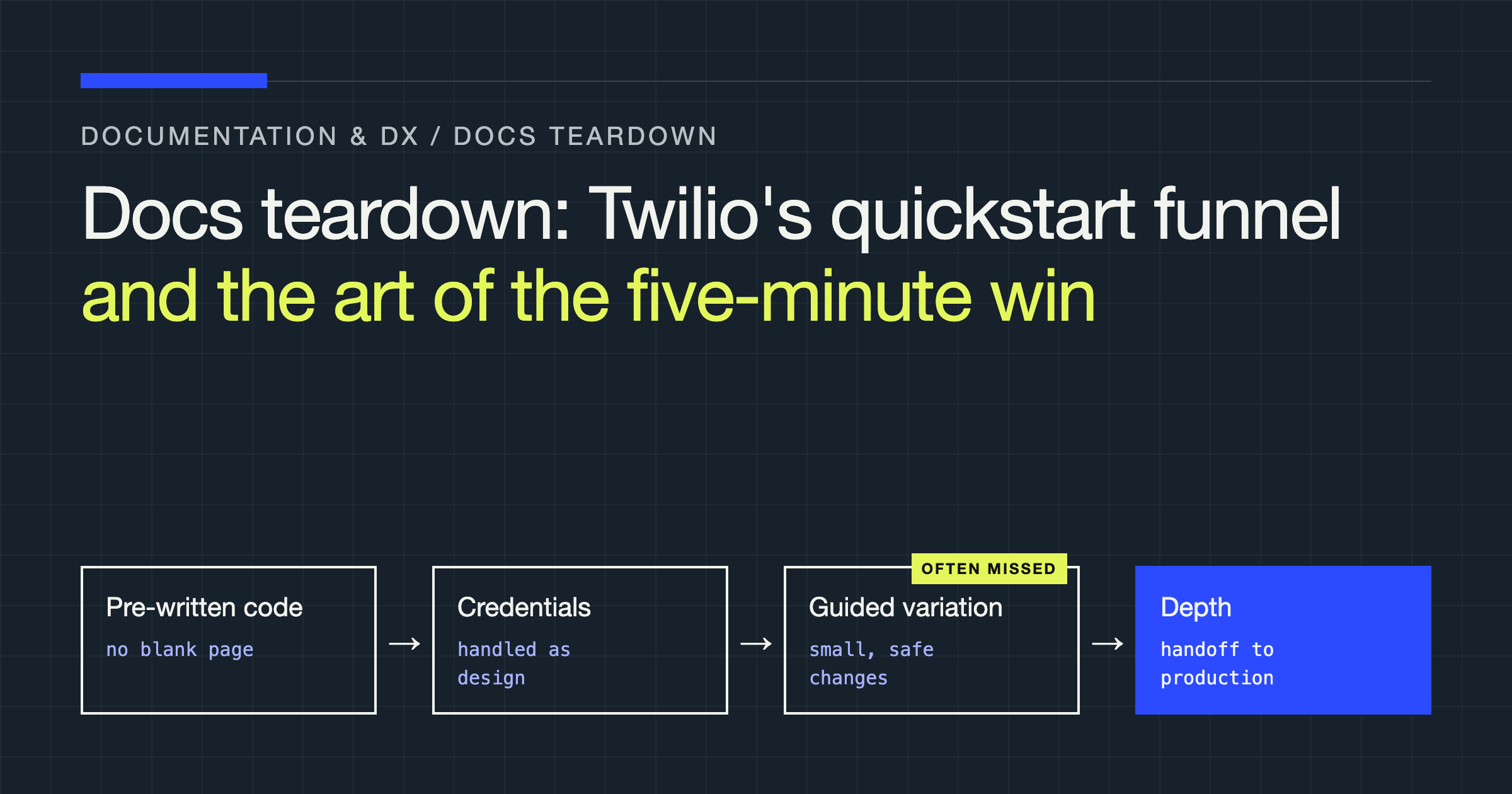
By the end of this teardown you will be able to dissect any quickstart the way Twilio builds them: as a funnel with a measurable job at each stage, not as a short tutorial that happens to sit at the front of the docs. Twilio’s quickstarts are famous for getting a working result — historically, a real text message landing on a real phone — in front of a brand-new developer within minutes. That speed is not an accident of good writing. It is an architecture, and every stage of it makes a trade you should understand before copying it.
Stage one: kill the blank page
The defining decision in a Twilio quickstart is that you do not write the interesting code. You download or copy a complete, working example in your language, add your credentials, and run it. The intellectual work — structuring the API call, handling the client library, formatting the request — is done for you in advance.
This inverts the usual tutorial logic, and it is worth being precise about why it works. A new developer evaluating an API has one question: does this thing do what I need, in my stack, without a fight? Writing code from scratch answers that question slowly and with maximum friction. Running provided code answers it in minutes. Twilio is not teaching you its API in the quickstart; it is proving the API deserves to be learned.
The cost is equally clear. A reader can complete a Twilio quickstart and understand almost nothing about what they ran. If your docs funnel ends there, you have produced users who can demo and cannot build. Twilio’s design accepts this risk because the quickstart is explicitly stage one of a longer path — the failure only materialises when a docs team copies the quickstart pattern and forgets to build what comes after it.
Stage two: credentials, handled as a design problem
Every API quickstart has a swamp in the middle: account creation, credential retrieval, and environment setup. This is where developer patience goes to die, and Twilio’s docs treat it as a first-class design problem rather than an administrative preamble.
The pattern to notice is sequencing. The credential steps appear exactly when the running code needs them, not in a prerequisites block three pages earlier that you have forgotten by the time it matters. The docs tell you precisely where in the console each value lives and what to do with it — set it as an environment variable, do not paste it into source. That last instruction does double duty: it is setup guidance and security education delivered at the one moment the reader is guaranteed to act on it.
For your own docs, the transferable rule is this: never front-load credentials into a prerequisites list. Prerequisites are where readers skim. Put each secret in the reader’s hand at the step where the code first refuses to run without it, explain the safe handling in that same breath, and your quickstart stops leaking developers at the exact step that was never about your API at all.
Stage three: the language switcher and the illusion of seven docs
Twilio publishes its quickstarts across many programming languages, presented through a language selector on the same page. Underneath, this is one document with parallel code paths, maintained as a single editorial object. The benefit is consistency you can feel: whichever language you choose, the explanation, the order of operations, and the concepts are identical, so community answers, blog posts, and support replies stay relevant across stacks.
The trade-off is maintenance weight and a subtle quality risk. Parallel paths must be kept in lockstep; when one language’s example lags — an older library version, a deprecated method — the page quietly teaches two different APIs under one title. Twilio’s scale justifies a dedicated effort to prevent that drift. A smaller team copying the pattern should cut languages ruthlessly: three well-maintained paths beat seven decaying ones, because a broken quickstart in a reader’s language reads as a broken product, full stop.
Stage four: the handoff to depth
The most instructive part of the funnel is what a quickstart page does at the end. Instead of stopping at the working result, Twilio’s quickstarts route you onward: to the deeper guides for the capability you just exercised, to the API reference for the resource you touched, and to the production concerns the quickstart deliberately skipped — error handling, status callbacks, scaling behaviour, compliance obligations for messaging.
Score the funnel stages like this:
| Funnel stage | Its job | How Twilio does it | What breaks if you skip it |
|---|---|---|---|
| Working result | Prove the API works in your stack | Complete provided code, minimal setup | Readers churn before any success |
| Credential moment | Get secrets configured safely | Just-in-time steps inside the flow | Setup abandonment, secrets in source code |
| Guided variation | Turn running code into understanding | “Now change this” steps on the working example | Demo-only users who cannot adapt the code |
| Depth handoff | Route to guides, reference, production topics | Explicit next-step links matched to what was built | Quickstart becomes a dead end |
Notice the third row, because it is the one most teardowns miss. Between “run our code” and “read the reference,” Twilio inserts guided variation: small, safe modifications to the working example — change the message, change the recipient, respond to an incoming message instead of only sending one. This is where learning actually happens, on top of a foundation the reader already trusts. If you design quickstarts, budget more words for this stage than feels necessary. It is the bridge between your funnel’s promise and your product’s retention.
The phone-number moment: teaching by consequence
There is a smaller design decision inside the classic Twilio quickstart that deserves its own examination, because it teaches a lesson most tutorials never attempt. Early in the messaging flow, the developer encounters the concept of the sending number: the message does not come from “Twilio,” it comes from a number you provision, and the quickstart walks you through obtaining and using one as a step in the flow rather than a concept to study first.
What is instructive is the ordering of concept and action. The docs let you perform the step, then explain what you have just done and why it matters — deliverability, identity, reply handling. Education researchers call this a “productive first encounter,” but you do not need the term to see the mechanics: motivation is highest immediately after an action succeeds, because the developer now owns something — a working number, a sent message — and wants to understand the thing they own. Concepts taught before the encounter are homework. Concepts taught after it are answers.
Most API documentation gets this backwards, front-loading architecture explanations before the first request on the theory that understanding should precede action. Twilio’s funnel demonstrates the opposite bet at every stage: action first, explanation at the moment of curiosity, depth on demand. When you design onboarding for any API with a provisionable resource — keys, numbers, workspaces, indexes — audit your order of operations. If your readers meet the concept three pages before they touch the thing, you have scheduled the explanation for the moment they care about it least.
Consistency as a trust signal
One final property of the funnel is easy to miss because it is an absence: the quickstarts do not feel like they were written by different teams in different years. Terminology is stable across products, the shape of a page — goal, code, explanation, next steps — repeats until it becomes a rhythm the reader can rely on, and the voice stays in the second person, present tense, one action per step.
That uniformity is doing commercial work. A developer evaluating an API is really evaluating the organisation behind it: will this platform be maintained coherently, will the docs for the next feature match the docs for this one, will support answer in the same vocabulary the docs use? A funnel with a ragged edge — one product’s quickstart in a different structure, another’s written in marketing voice — answers those questions badly at the exact moment of decision. Twilio’s editorial consistency is expensive to maintain across that many products and languages, which is precisely why it functions as a signal: it is hard to fake, and readers register it even when they cannot articulate it. Your docs do not need Twilio’s scale to borrow this. They need a template authors actually follow, a small style vocabulary enforced in review, and the discipline to rewrite the odd page out rather than letting inconsistency accumulate one exception at a time.
Where the model strains
Honesty about limits: the funnel assumes a developer who is evaluating, with permission to experiment and a phone in their pocket. It serves regulated or procurement-led adoption poorly — an enterprise architect assessing messaging compliance does not want a five-minute win; they want deliverability policy, data handling, and regional rules, and Twilio quite sensibly serves them through entirely different content. The quickstart funnel is an acquisition instrument. Teams that mistake it for their whole documentation strategy end up with superb onboarding wrapped around a hollow core.
There is also a freshness tax. A funnel this engineered — console screenshots, credential locations, console flows — decays every time the console is redesigned. Twilio pays that tax at scale. You should decide in advance whether you can, because a funnel with one rotten step converts worse than no funnel at all.
Verdict
Twilio’s quickstarts endure as the reference design because they respect a sequence most docs get backwards: proof before teaching, credentials at the moment of need, variation on a trusted base, and an explicit handoff to depth. Copy the sequence, not the surface. Your version needs a working result a stranger can reach in minutes, one honest bridge from running code to understood code, and next steps that treat the quickstart as the beginning of the relationship — because for your reader, that is exactly what it is.