Merchant-facing articles / Tutorial
Etsy fees explained: what you actually keep from each sale (free calculator)
Etsy takes about 10% of each US sale plus $0.45 in fixed charges. See every fee, a worked example, a pricing formula and a free calculator to price for profit.
If you’re selling on Etsy in the US, expect to pay roughly 10% of each sale in standard fees, plus $0.45 in fixed charges, before advertising costs. For example, if you sell an item for $30, you’ll pay $3.30 in Etsy fees (assuming no additional shipping charges or sales tax), leaving you with $26.70 before deducting your business expenses.
Use the free Etsy fee calculator below to work out how much you actually make from each sale and what you should charge to reach your target profit.
Every fee that touches a sale
Before you set a price for your product, you need to understand what Etsy charges you and how those charges affect your profit. Some fees are unavoidable, while others depend on where your business is based, how customers discover your products, and which currency you use to sell.
Fees you always pay
These are the three standard fees you should account for when pricing any product on Etsy.
| Fee | Rate | When it applies | Can you avoid it? |
|---|---|---|---|
| Listing fee | $0.20 | When you publish or renew a listing, and for additional quantities sold. | No |
| Transaction fee | 6.5% | When you make a sale, including any shipping and gift-wrapping charges. | No |
| Payment processing fee | 3% + $0.25 (US) | On each order, including shipping and applicable sales tax. | No |
Sources: Etsy Fee Basics and Etsy Payment Processing Fees.
If you’re a US seller, these fees work out to 9.5% plus $0.45 for a typical single-item sale, excluding sales tax. Payment processing rates vary by country, so check the rate for your bank account location before calculating your prices.
Fees you sometimes pay
Depending on your location, shop settings, and how you generate sales, you may also need to account for the following fees.
| Fee | Rate | When it applies | Can you avoid it? |
|---|---|---|---|
| Offsite Ads fee | 12% or 15% | When a sale is attributed to an Etsy Offsite Ad. | Yes, if eligible to opt out. |
| Currency conversion fee | 2.5% | When your listing currency differs from your payment account currency. | Yes, by using matching currencies. |
| Regulatory Operating fee | 0.05%–1.97% | When you sell from certain countries, including the UK, Canada, and France. | No, if applicable in your country. |
Sources: Etsy Fees & Payments Policy, Currency Conversion Fees, and Regulatory Operating Fees.
Offsite Ads deserve particular attention because they can significantly reduce your profit. If your shop has made less than $10,000 in sales over the previous 365 days, you can opt out and otherwise pay a 15% fee on attributed orders. Once you reach that threshold, participation becomes mandatory, but your rate drops to 12%. The fee is capped at $100 per attributed order.
You should also budget separately for other potential expenses, such as Etsy Ads, listing renewals for unsold products, subscriptions, shipping labels, deposit fees, and applicable taxes on seller fees. While these expenses may not apply to every order, they still affect your overall profitability.
The traps that catch new sellers
Even when you know Etsy’s standard fee rates, it’s easy to underestimate how much you’ll pay. Here are four common pricing mistakes that can reduce your profit.
Forgetting that Etsy charges fees on shipping
Etsy’s 6.5% transaction fee applies to both the item price and the shipping amount you charge your customer. If you sell a product for $30 and charge $5 for shipping, Etsy calculates the transaction fee on $35, meaning you’ll pay $2.28 instead of $1.95. Payment processing fees also apply to shipping, so charging customers exactly what it costs you to ship an item may leave you covering part of that expense yourself.
Assuming the listing fee is a one-time expense
If you list a product with 100 units in stock, you initially pay $0.20 to publish the listing. As units sell, Etsy charges additional listing or renewal fees. You should therefore account for the $0.20 listing fee per unit when calculating your long-term profit, rather than treating it as a one-time setup expense.
Underestimating the impact of Offsite Ads
An order generated through Offsite Ads can cost you an additional 12% or 15% of the order total, on top of your standard Etsy fees. On a $50 sale with no additional shipping charges or sales tax, a 15% Offsite Ads fee would bring your total Etsy fees to $12.70. That’s 25.4% of your sale gone before you account for materials, packaging, labor, or shipping expenses.
Overlooking currency conversion fees
If your listing currency differs from your Etsy payment account currency, Etsy charges a 2.5% currency conversion fee. For example, if you list your products in US dollars but your payment account uses British pounds, a $100 sale could incur an additional $2.50 in conversion fees. You can avoid Etsy’s currency conversion fee by listing your products in the same currency as your payment account, although your bank may still charge separate conversion fees.
Worked example: what you actually keep
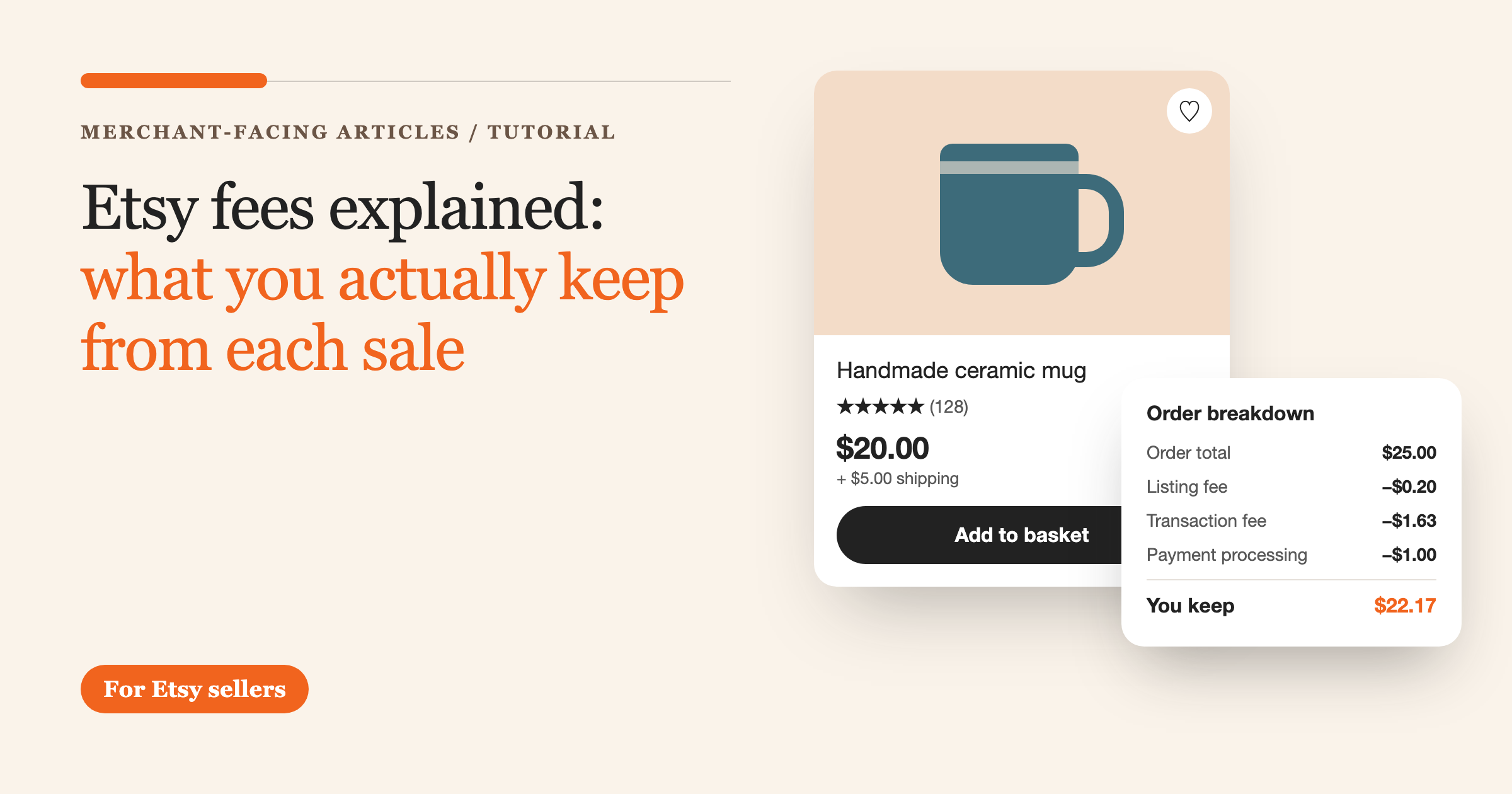
Let’s say you sell a handmade mug for $20 and charge your customer $5 for shipping. Your customer pays $25 before sales tax, but how much of that money do you actually keep?
Assuming you’re a US seller and the order doesn’t include sales tax, here’s how the fees break down.
| Description | Amount |
|---|---|
| Item price | $20.00 |
| Shipping charged | $5.00 |
| Total order value | $25.00 |
| Listing fee | −$0.20 |
| Transaction fee (6.5%) | −$1.63 |
| Payment processing fee (3% + $0.25) | −$1.00 |
| Amount you keep | $22.17 |
Now imagine that the same customer discovered your mug through an Offsite Ad, and your shop is subject to the 15% advertising fee.
| Description | Amount |
|---|---|
| Total order value | $25.00 |
| Listing fee | −$0.20 |
| Transaction fee | −$1.63 |
| Payment processing fee | −$1.00 |
| Offsite Ads fee (15%) | −$3.75 |
| Amount you keep | $18.42 |
| Sale | Fees | Remaining revenue |
|---|---|---|
| Standard sale | $2.83 | $22.17 |
| Offsite Ads sale | $6.58 | $18.42 |
The same product, sold at the same price, leaves you with $3.75 less simply because of how the customer found your listing.
Keep in mind that neither $22.17 nor $18.42 represents your actual profit. You still need to deduct the cost of making the mug, packaging it, and shipping it to your customer. If those expenses total $12, your profit drops to $10.17 on a standard sale and $6.42 on an Offsite Ads sale. That’s why accounting for fees before setting your prices matters.
Your true costs, not just Etsy’s
Knowing how much Etsy takes from each sale is only part of the pricing equation. To calculate your actual profit, you need to account for everything it costs you to produce, package, and deliver your product.
Here are the expenses to include in your calculations:
- Materials: Everything you use to make the product, including smaller supplies such as glue, ink, paint, and thread.
- Packaging: Boxes, mailers, protective wrapping, labels, and thank-you cards.
- Actual postage: What you pay the shipping carrier, regardless of what you charge your customer.
- Labor: The time you spend making, personalizing, and packing each item, multiplied by your desired hourly rate.
- Overhead: A reasonable share of expenses such as product photography, equipment, tools, and software subscriptions.
Using the $20 mug from our previous example, here’s what your production and fulfillment costs might look like.
| Expense | Cost per item |
|---|---|
| Materials | $3.00 |
| Packaging | $1.00 |
| Actual postage | $5.00 |
| Labor ($20/hour × 15 minutes) | $5.00 |
| Allocated overhead | $0.50 |
| Total cost | $14.50 |
After deducting these costs from the $22.17 you keep after standard Etsy fees, your actual profit is $7.67. If the sale came through a 15% Offsite Ad, that profit drops to $3.92.
One of the easiest expenses to overlook is your own time. Even if you make every product yourself, include labor in your pricing calculations. Otherwise, what appears to be a healthy profit may simply be compensation for hours of unpaid work. Your prices should cover your expenses, compensate you for your time, and leave enough profit to grow your business.
The pricing formula
Instead of setting a price and hoping there’s enough money left after Etsy deducts its fees, start with the profit you want to make and work backwards. This way, you can set a price that covers your expenses, accounts for Etsy’s fees, and leaves you with your desired profit.
First, calculate your target take-home amount by adding your total costs to your desired profit.
Then, if you’re a US seller, use the following formula to calculate what your customer should pay:
Here’s where those numbers come from:
- $0.45: The $0.20 listing fee plus the fixed $0.25 payment processing fee.
- 0.905: The proportion of your revenue remaining after Etsy deducts its 6.5% transaction fee and 3% payment processing fee.
Putting the formula into practice
Suppose your total costs are $12 and you want to make an $8 profit. Your target take-home amount is $20.
Here’s how that price breaks down:
| Description | Amount |
|---|---|
| Total selling price | $22.60 |
| Etsy fees | −$2.60 |
| Take-home amount | $20.00 |
| Total costs | −$12.00 |
| Actual profit | $8.00 |
If you charge $5 separately for shipping, your item price would be $17.60, bringing the total order value to $22.60.
This formula assumes a standard US sale without advertising fees, currency conversion fees, or sales tax. If you’re selling outside the US, use your country’s payment processing rate and account for any additional applicable fees. The calculator below helps you do this without having to adjust the formula manually.
Free Etsy fee calculator
You don’t have to work through the pricing formula every time you list a new product or adjust your prices. Use the calculator below to see how much Etsy takes from each sale, how much profit you make after expenses, and what you need to charge to reach your target profit.
Etsy fee & profit calculator
Calculate your earnings and find your ideal selling price.
Your results
Fee breakdown
- Listing fee
- Transaction fee (6.5%)
- Payment processing
- Offsite Ads
- Currency conversion
- Regulatory operating fee
- Total fees
- Total business costs
Price needed to earn in profit
- Recommended item price
- Plus shipping
- Total order price
How to use the calculator
- Select your bank account country so the calculator uses the appropriate payment processing rate.
- Enter your current item price and the shipping amount you charge your customer.
- Enter your actual expenses, including materials, packaging, postage, labor, and overhead.
- Enable any additional fees that apply to your sale.
- Enter your desired profit to find out how much you should charge.
Example: Pricing your handmade mug
Using the same mug from our earlier example, enter a $20 item price, $5 shipping charge, and $14.50 in total business costs. Set your target profit to $10.
The calculator returns the following results for a standard US sale:
| Result | Amount |
|---|---|
| Total order value | $25.00 |
| Etsy fees | $2.83 |
| Take-home amount | $22.17 |
| Actual profit | $7.67 |
| Profit margin | 30.68% |
| Recommended item price | $22.57 |
| Recommended price including shipping | $27.57 |
You’ve now identified how much you need to increase your price to reach your target profit. You can also enable Offsite Ads to see how an advertising fee would affect your earnings before deciding on your final selling price.
The calculator uses Etsy’s published payment processing rates, regulatory operating fees, and selling fees.
Pricing strategies that protect your margin
Once you know how much you need to charge to make a profit, you can experiment with different pricing strategies to protect your margins without making your products less appealing to customers.
Free shipping vs. charging for shipping
From a fee perspective, selling an item for $25 with free shipping is generally the same as selling it for $20 with $5 shipping. Etsy calculates its transaction and payment processing fees on the combined amount.
However, buyers may respond differently to each pricing structure. Some prefer seeing the full price upfront, while others are attracted to a lower initial product price. Experiment with both approaches and compare your conversion rates and profit per order. If you offer free shipping, make sure the actual shipping cost is built into your product price.
Sell products in bundles
Bundling complementary products can increase your average order value while reducing certain costs per item. For example, selling three mugs as a single bundle means paying one listing fee and one fixed payment processing fee for the order. You may also save on packaging and postage compared with shipping three separate orders.
Percentage-based fees still apply to the full order value, so use the calculator to make sure any bundle discount leaves you with a healthy profit.
Decide whether Offsite Ads are worth it
If your shop has never reached $10,000 in Etsy sales over a consecutive 365-day period, you can opt out of Offsite Ads. Before making that decision, calculate whether your products remain profitable after the additional 15% advertising fee.
Once your shop reaches that threshold, participation becomes mandatory for the lifetime of your shop, and the fee drops to 12%. If you can no longer opt out, account for potential advertising fees when setting your prices, particularly for products with narrow profit margins.
Review your prices every quarter
Your production costs, postage rates, packaging expenses, and Etsy fees can change over time. A product that was profitable six months ago could be earning considerably less today, even if your sales volume has increased.
Set aside time every three months to review your expenses, check Etsy’s current fee rates, and run your products through the calculator again. Adjusting your prices regularly helps you protect your profit margins before rising costs become a bigger problem.
Frequently asked questions
Does Etsy charge fees on sales tax?
For US sellers, Etsy’s 6.5% transaction fee excludes sales tax. However, the payment processing fee is calculated on the total amount the buyer pays, including applicable sales tax. This means that even when Etsy collects and remits sales tax on your behalf, you still pay a processing fee on that amount.
What happens to the fees when I refund a buyer?
When you issue a refund through your Etsy Shop Manager, Etsy automatically credits the corresponding transaction and payment processing fees to your payment account. For partial refunds, these fee credits are proportional to the refunded amount. If you also cancel the order, Etsy credits the listing fee. However, if you issue a refund outside Etsy’s payment system, Etsy cannot refund your seller fees.
Is there a monthly fee to sell on Etsy?
No. Etsy Standard does not require a monthly subscription. You pay the applicable listing, transaction, payment processing, and other selling fees, although a one-time shop setup fee may apply when you open your shop.
Etsy also offers an optional Etsy Plus subscription for $10 per month, which includes additional shop customization options, listing credits, advertising credits, and other seller tools. You don’t need this subscription to start or run a profitable Etsy shop.
Etsy fees: quick-reference card
Etsy pricing cheat sheet
US sellers · Single-item order
Standard fees
- Listing fee
- $0.20
- Transaction fee
- 6.5%
- Payment processing fee
- 3% + $0.25
- Combined standard fees
- 9.5% + $0.45
Additional fees
- Offsite Ads
- 12% or 15%
- Currency conversion
- 2.5%
- Regulatory operating fee
- Varies by country
Your pricing formula
Your profit formula
Before setting your price, account for:
- Materials and packaging
- Actual postage
- Labor (hours × hourly rate)
- Overhead and equipment
- Applicable additional fees
The pricing formula excludes additional fees and sales tax. Payment processing rates vary by country. Review your prices every three months.
Keep this cheat sheet handy whenever you create a new listing, run a promotion, or adjust your prices.